
Interview by Julien Leprovost.
French original here.
Botanist Francis Hallé is pursuing his ambition of reviving a primary forest in Western Europe. To convey his message, in September 2021, with Actes Sud Editions, Hallé published a manifesto in defence of the return of a primary forest in the region. We had the opportunity to speak with Francis Hallé and take stock of this unique and ambitious rewilding project.
What message do you want to send with your manifesto Pour une forêt primaire en Europe de l’Ouest [For a primary forest in Western Europe]?
I explain why we need a primary forest, in particular, in particular to provide a place for life. Since we are only at the start of the operation I’m also writing this text so that we don’t lose sight of the initial objectives along the way.
You place great emphasis on the beauty of a forest. Can this argument alone be enough to convince us to dedicate 70,000 hectares to it for 1000 years, and more?
Certainly not, because beauty alone cannot justify the project. I don’t only insist on beauty, but I happen to like it, and it’s something that never gets talked about. I am learning about beauty, a subject on which there’s an enormous bibliography which focuses mainly on artistic aspects and very little on nature, despite the fact that primary, virgin nature is undeniably magnificent. But this is not the only reason we need a primary forest.
What other, more pragmatic reasons do you put forward?
These reasons are already well documented. The primary forest offers maximum biodiversity, maximum CO2 capture, maximum carbon fixation, maximum soil fertility and maximum soil stability since the trees encourage rainwater to sink down to their roots.
Such a project poses profound philosophical and anthropological questions. Indeed, human beings, who tend to want to control everything, are reluctant to embark on a project that consists precisely of letting nature take its course. Do you get the impression that one obstacle to its realization lies in the ego of the human species?
This is indeed the main obstacle, if not the only one, to our primary forest project in Western Europe. For a species that doesn’t like to let go, a freely evolving forest constitutes a resignation, an abandonment and something shameful. But this point of view is not based on anything concrete. I believe that human beings will have to find a fairer place in nature; this is one of the objectives of the initiative.
How can we overcome this obstacle and change people’s point of view?
I’m not going to try to change everybody’s views. And I certainly can’t put them all in the same box. There are some who are terribly anthropocentric while others have understood very well that nature doesn’t need us and is much better off when we don’t take care of it. So I’m going to work with those people.
Where are you with the primary forest initiative?
In the coming weeks, we will visit the borders with the five countries around us. The project must be cross-border. We’re starting with the Vosges and then going to the Ardennes, in which I have a lot of hope, and then to the German, Swiss, Italian and Spanish borders.
Will the site be accessible to visitors?
The forest will not be closed off to human beings. I refuse the expression “protected forest” or “forest sanctuary”. Visits will be allowed and even encouraged. This initiative is made for our contemporaries and for future generations.
What would you like people living in Europe’s primary forest region to do and say about it in 1000 years?
I would like them to visit it and admire it. They will benefit from the contributions that large trees will provide in terms of oxygen, land and water purification and soil fertilization. They will have a primary forest near them, which these days is quite exceptional. I hope they will be proud of it.
Is there a project built over a long period of time or which took centuries to see the light of day that inspired you?
Bringing back a primary forest is, to my knowledge, a totally original project. I guess the pyramids of Egypt or the cathedrals took a while. If we no longer know how to work in the long term, then it becomes very worrying.
Do long-term projects still have a place? Are we not neglecting the long term in favor of the short term?
In our daily life, everything we do is geared towards saving us a few seconds, from computing to transport. We have to go faster and faster without knowing why… Saving a fraction of a second is considered a victory. I disagree with this, because the truly important things are worth spending time on.
Isn’t this need for immediacy a reflection of a loss of meaning as well as a fear of death present in the modern era?
It’s possible, but it doesn’t concern me. I’ve become used to the rhythm of the trees. They work very slowly, but for a very long time. Some of them are immortal.
Do you have any final thoughts?
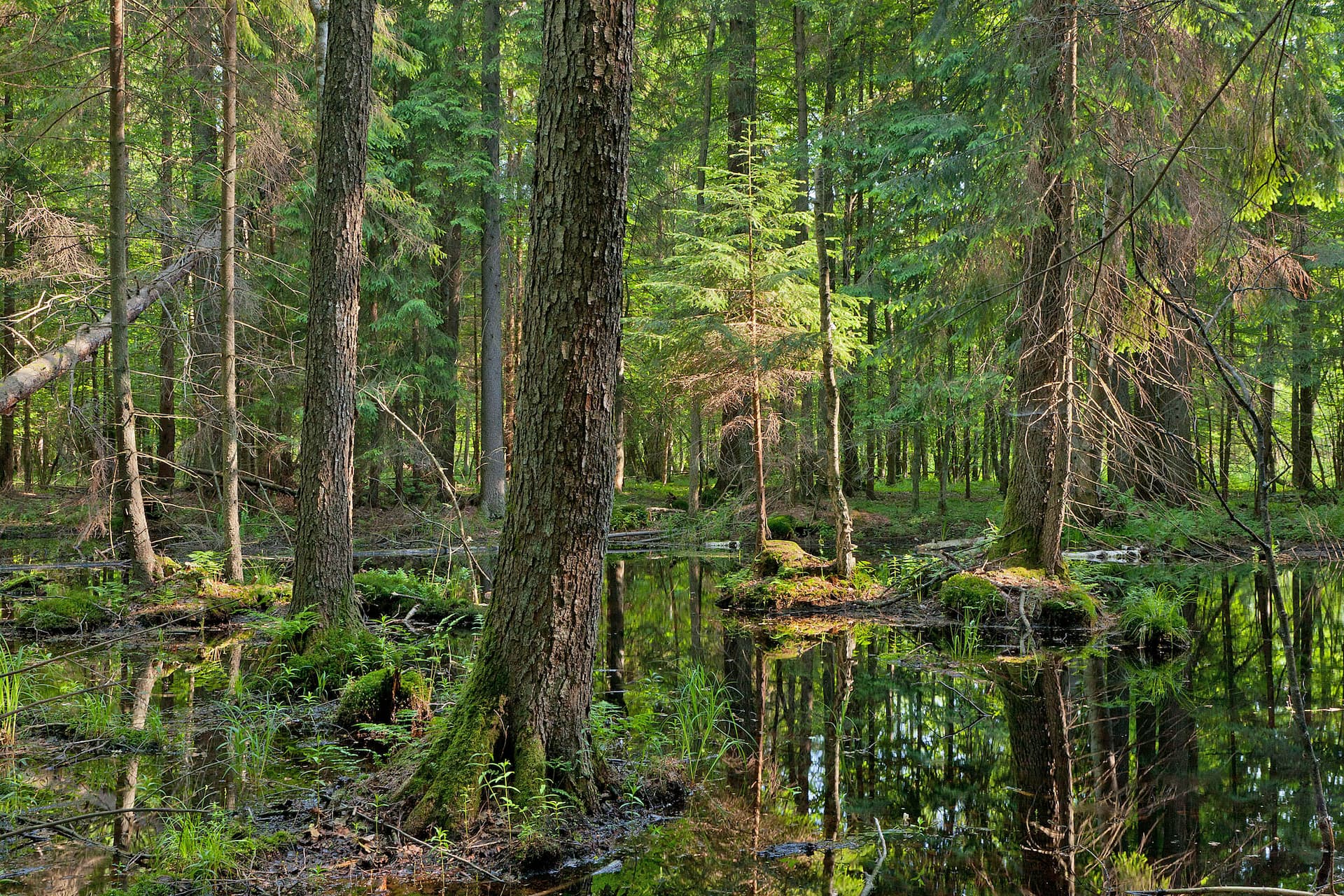
If you have the means, get yourself to the last primary forest in Europe, located on the border between Poland and Belarus. Her name is Bialowieza and her beauty is absolutely unforgettable.
 James Horrox