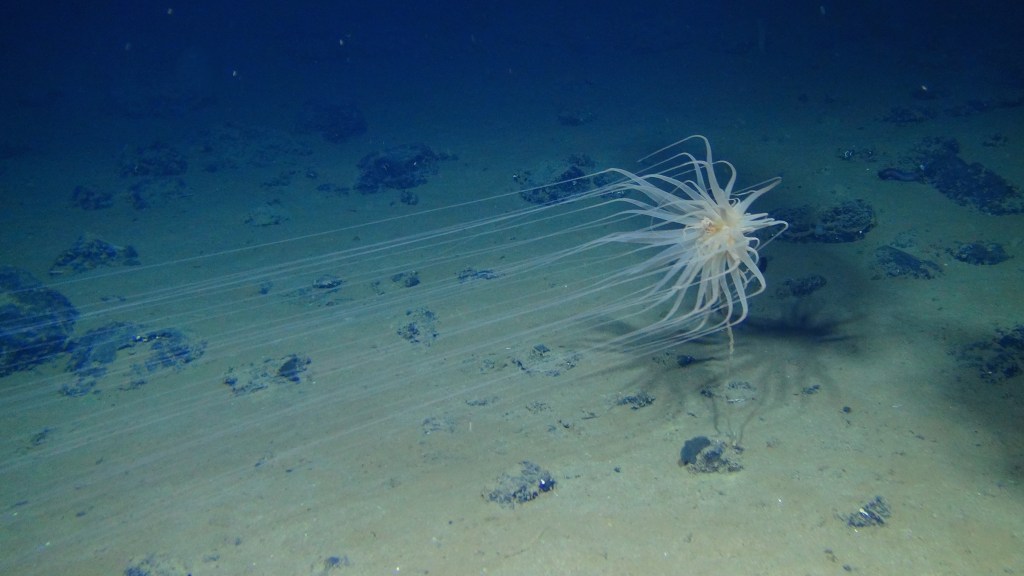
The presence of large stores of minerals in the deep ocean has been known for more than half a century. The possibilities for commercial harvesting of these deposits – rich in valuable metals, including zinc, cobalt, copper, nickel and gold – were being discussed as far back as the 1970s, but only in the last few years has large-scale extraction of these resources come to be considered a realistic possibility.
Advances in deep-sea technology and growing demand for the metals now known to exist in abundance on the ocean floor, such as cobalt and nickel, have led to renewed attention and investment in deep-sea mining. While the technological and economic viability of this expensive and complex form of resource extraction are still unclear, interest in large-scale seafloor mining is on the rise.
The deposits of the most interest to deep-sea mining advocates take three forms.
Ferromanganese nodules
Current interest in deep-sea mining is focused mainly on ferromanganese nodules, also called “polymetallic nodules”: small, potato-size mineral accretions formed on the ocean floor. These deposits contain multiple metals, such as cobalt, copper, nickel, manganese, as well as rare earth and other minerals.
Nodule accumulations exist across vast areas of the abyssal plain – flat areas of seafloor at depths of between 3,000 and 6,000 meters. Current commercial exploration is focused on four geographic regions in particular: the Penrhyn Basin in the south-central Pacific; the Peru Basin in the south-east Pacific; the center of the north Indian Ocean; and, most of all, the 1.7 million-square-mile Clarion-Clipperton Fracture Zone (CCZ) in the north-central Pacific.
The Clarion-Clipperton Zone nodule field is the largest of the known fields, both in geographical area and the mass of nodules it contains. By one estimate, a single square meter of ocean floor in this zone contains on average around 15 kilograms (33 pounds) of nodules, and in some cases up to 75 kilograms (165 pounds). A 2022 study estimates the total mass of nodules in the CCZ nodule field as around 21.1 billion tons, noting that this figure is itself a conservative estimate.
Hydrothermal sulfides
Hydrothermal sulfides, also known as polymetallic sulfides, are formed through hydrothermal vent activity near mid-ocean ridges where tectonic plates are moving apart, which releases superhot, mineral-rich water into the surrounding ocean. Heated by magma beneath the Earth’s surface, the water picks up dissolved minerals as it travels through the oceanic crust, and when this water meets the cold seawater, it precipitates minerals, forming chimney-like structures. Where this activity has occurred over long periods of time, there can be thick deposits of these sulfides under the seafloor.
These deposits contain high concentrations of valuable minerals, including metals such as copper, gold, silver, zinc and rare earth elements. Deposits at a single vent can contain millions of metric tons of ore.
Ferromanganese crusts
Ferromanganese crusts, also known as “cobalt crusts,” are deposits formed over the course of millions of years on the surfaces of seamounts and other hard substrates on the ocean floor, containing cobalt, nickel, copper and rare earth elements. The Pacific Ocean Prime Crust Zone, thought to be the region containing the greatest quantity of crust deposits, is estimated to hold around 7.5 billion dry tons of cobalt-rich ferromanganese crusts. These deposits are thought to hold greater quantities of certain elements than any terrestrial reserve, but these estimates are based on few actual measurements.
Deep-sea mining is a threat to the ocean
The deep ocean where these untapped resources lie is known to be a vibrant, biodiverse place, teeming with complex ecosystems and thousands, possibly millions of species, many of which scientists are only now beginning to learn about, and likely many more yet to be discovered.
The extreme conditions and relative inaccessibility of the regions of ocean of most interest for commercial mining have led to a lack of scientific research on this last great wilderness. Hence, the nature of the habitats, species and ecosystems that will be impacted by mining is only just beginning to be understood. Recent research, however, has indicated both the wealth of biodiversity in deep-sea habitats and how much we have yet to learn about it. One 2023 study, for example, identified more than 5,000 as-yet-unnamed marine species in the Clarion-Clipperton Zone alone.
The ocean’s abyssal plains, where most of the current international interest in deep-sea mining is focused, are the largest habitat on the planet. Characterized by soft sediment, mainly composed of clay, silt, and the remains of marine organisms, their unique conditions provide habitat for organisms adapted to extreme depths, high pressures, darkness and cold temperatures. Waters of the abyssal plains are some of the clearest seawater on Earth, since there is very little particulate matter raining down from the surface ocean. The diverse wildlife that inhabits these and other parts of the deep ocean of interest to mining advocates includes deep-sea fish (some of which, like the black oreo, orange roughy and sablefish, can live to be a century old or more); invertebrates (such as sea cucumbers and deep-sea corals and sponges); a wide variety of snails, mussels, clams and worms; and the diverse microbial life that forms the basis of marine food webs, allowing other species to thrive.
These vast, flat plains are punctuated by hills, valleys, seamounts, underwater mountain ranges and other topographical features, many of which are hotspots for biodiversity. A 2015 study of abyssal hills, for example – small hills that rise from the floor of an abyssal plain – found an astonishing array of life: arthropods such as squat lobsters and sea spiders, stalked sea squirts, a variety of different kinds of deep-sea anemones and sea cucumbers, starfish and their relatives brittle stars (also known as serpent stars), crinoids (a class of invertebrates including sea lilies and feather stars), spoon worms, sponges, single-celled planktonic animals, and a number of unknown species.
The full extent of the damage mining operations will inflict on this mysterious and still largely unexplored underwater world has likewise yet to be definitively established. However, a growing body of research indicates that disturbing these delicate environments will cause substantial, and most likely irreparable harm to marine species and ecosystems – both at the mining sites themselves and across hundreds, and potentially thousands of miles of surrounding ocean.
Impacts to the mining area
Deep-sea mining could take place in various parts of the deep ocean, with different types of mineral resources being targeted depending on the geological characteristics of each region. Each of the three main areas of interest for commercial mining is teeming with its own unique habitats and ecosystems, and mining in each of these areas will inflict its own specific set of harms, with long-lasting and, in some cases, likely irreversible effects on the biodiversity and structure of ocean habitats.
To be economically viable, deep-sea mining will likely need to take place on a huge scale. By one estimate, for a nodule operation to be financially viable it would have to mine around 400 square kilometers (150 square miles) of seabed every year – an area roughly the size of Philadelphia. Others have suggested 300 square kilometers (around 120 square miles) per year. Another projection suggests that a single operation would mine roughly 8,000 to 9,000 square kilometers (3,000 to 3,500 square miles) over a 30-year mining license period. Another has calculated that, in the approximately 29,000-square mile (75,000-square kilometer) area of the CCZ in which Germany has been licensed to conduct mining exploration, roughly 2.2 million tons of nodules would have to be extracted for the mining to be commercially viable. In short, while assessments of its profitability vary, there is broad agreement that for deep-sea mining to be financially worthwhile, its ecological footprint would have to be enormous.
* * *
Most obviously, the damage to ocean ecosystems would stem from the fact that mining operations literally rip up substantial areas of the ocean floor, and therefore the species that rely on it for their habitat.
Nodule mining
Extraction of ferromanganese nodules from the seabed is currently carried out by remotely operated vehicles and mining machines equipped with cutting and suction tools to vacuum up nodules from the seafloor. Propelled by caterpillar tracks (like those of tanks or bulldozers) and weighing up to 250 tons, these giant machines drive across the seabed, cutting or sucking up the nodules, which are then piped up to the surface with pumps or riser systems and transferred to a surface vessel for processing. Trials of a 70-ton-plus prototype of one of these vehicles in 2022, one of which ripped up around 4,500 tons of nodules from an 80-kilometer long stretch of the Pacific Ocean floor, have been hailed as a success by mining advocates, and this system is now set to be scaled up for future trials.
This highly destructive process would impact large areas of sensitive habitat.
- A 2016 survey of four sites in the eastern Clarion-Clipperton Zone similar to the ones currently in the sights of deep-sea mining advocates found a large degree of habitat diversity compared with other areas of the abyssal plain, and with it, a diverse array of life, with 170 distinct types of megafauna found in one 30-square kilometer study area. These organisms include brittle stars, sea anemones, sponges and deep-sea corals. Of the 12 metazoan species collected during the study, seven were previously unknown to science, including three new genera.
- A study published in 2016 comparing creatures associated with ferromanganese nodules in four areas of the Clarion-Clipperton Zone with different levels of nodule coverage found that densities of epifauna are more than twice as high in dense nodule fields as in areas with few or no nodules, and that some organisms, including certain soft corals, are “virtually absent” from nodule-free areas.
- The nodules themselves support diverse habitats and organisms. In the abovementioned 2016 survey, roughly half of the types of organisms identified were found exclusively on the nodules. Species associated with nodules include actiniarians (a genus of sea anemones); alcyonacean corals (commonly known as soft corals) and antipatharian corals (black or thorn corals); and hexactinellid sponges (also known as glass sponges). These structure-forming species often play an important role in creating habitats for other animals that depend on seafloor areas for part or all of their lifecycle.
The organisms that live on polymetallic nodules are linked to the rest of the marine ecosystem up the water column to the ocean surface and contribute to the health of the wider ocean.
- Nodules play a key role in the marine food web. A 2021 study of the CCZ and the Peru Basin concluded that taking out key “compartments” of the food web (in particular, disrupting interactions between nodules and the organisms attached to them, and between those organisms and their associated fauna) would have cascading effects throughout the food web, likely resulting in reduced biodiversity on and near the seafloor in the surrounding area.
Nodule mining is by its very definition a destructive process that would do major damage to large areas of sensitive habitat. In much of the deep ocean, hard surfaces like those of ferromanganese nodules are valuable real estate for sessile ocean creatures, providing irreplaceable habitats, including for creatures that themselves play a key role in creating habitats for other organisms and thus structuring marine ecosystems.
Crusts and seamounts
Cobalt-rich ferromanganese crusts form on submerged rock surfaces, most commonly on the rocky flanks and summits of seamounts – underwater mountains rising 1,000 meters or more from the ocean floor. The thickest and most cobalt-rich crusts are found at depths of 800 to 2,500 meters on the sides of underwater mountain ranges and seamounts in the western Pacific. A recent study highlights that a large fraction of seamount habitats in this region have already been licensed for mining exploration, with little remaining for targeted protection.
Mining operations targeting these crusts would typically involve deploying dredges or hydraulic suction systems to remove the crusts from the seabed and transporting the collected crusts to a surface vessel for processing. As with nodule extraction, these processes put vulnerable marine habitats and wildlife communities at risk.
- Studies of ferromanganese crusts have found highly diverse communities of many species, particularly filter-feeders, adapted to the seamount habitats where these crusts are found. National Oceanic and Atmospheric Administration surveys of these areas have found thriving populations of corals, sponges and other invertebrates.
- Seamounts support a rich array of life, including deep-sea corals, fishes, cephalopods (octopi, squid, etc.), turtles, marine mammals and others. These unique environments attract major aggregations of sharks, seabirds and marine mammals, and are hubs of biodiversity for pelagic fish (i.e., fish that inhabit the upper zones of the open sea). Their rocky surfaces provide ideal conditions for corals and sponges, and the ecosystems they support generally contain a particular abundance of suspension feeders, such as corals, and benthic filter-feeding organisms.
- These creatures are in many cases important to the broader marine ecosystem. Corals and sponges, for example, are a food source for predators and provide habitat for many other species, including crabs, squat lobsters and sea stars. Deep-sea filter-feeding organisms function as a vital link in enabling energy and matter to flow between the deep-water and shallow-water parts of the ocean ecosystem. And so on.
- Seamount habitats are also thought to be important in fostering “speciation” – the process by which populations of a given species evolve to become distinct species – in the deep ocean, and potentially therefore play an important role in maintaining biodiversity in the deep sea.
Sulfide mining at hydrothermal vents
The superheated water ejected by active hydrothermal vents enables a unique ecosystem to thrive in the darkness of the deep ocean environment. These vents and their surroundings are home to a diverse array of life, with more than 500 hydrothermal vent species currently known to science, including tube worms, crabs, fish and microorganisms adapted to the hot, dark conditions in the areas around vents. These species tend to be endemic to these areas and can only survive in the unique conditions these habitats provide. Since research into these habitats is still in its relatively early stages, current knowledge of the extent of the biodiversity they support is almost certainly just the tip of the iceberg, and scientists expect many more species to be discovered as more vent fields are discovered.
The species that live among sulfide deposits created by past hydrothermal activity are even less well-studied than those surrounding active vents. It is these deposits that are currently the main focus of deep-sea mining interest.
Very little data exists on the ecosystems around these deposits, but research suggests that they support a range of flora and fauna. Organisms that rely on inactive deposits are typically sessile (i.e., attached to rocks or the seabed), filter-feeding, long-lived and slow-growing, and potentially include sponges, corals, anemones, squat lobsters, hydroids (a life stage of hydrozoa – small predatory animals related to jellyfish), ophiuroids (also called brittle stars or serpent stars – echinoderms closely related to starfish) and holothurians (more commonly known as sea cucumbers).
The current absence of knowledge about the ecology of seafloor hydrothermal sulfide deposits means that mining operations in these areas would likely damage or destroy ecosystems and habitats before we have had the chance to properly study them, and potentially even wipe out species we don’t yet know exist.
Effects beyond the mining area
While the full extent of the ecological damage likely to be inflicted by deep-sea mining is difficult to predict with the scant information currently available, it can reasonably be assumed that the direct removal of habitat – sucking up nodules, stripping the outer layers of seamounts, and so on – will destroy many of the organisms living directly on the materials being mined. Many of these organisms are found nowhere else on the planet, and some take so long to grow that their destruction could functionally spell extinction.
The impacts of mining will not be limited to the mining sites, however, nor the harms it inflicts confined to the species directly associated with these localized habitats. The process of mining the sea floor generates sediment plumes with the potential to affect sea life well beyond the area being mined.
Two types of plumes are potentially created when mining the seafloor:
- The collector plume (also called “benthic plume”) on and close to the ocean floor, created by the mining vehicles and machinery.
- The discharge plume (also called the “sediment plume” or “tailings plume”) in midwater. This consists of wastewater containing sediment and mine tailings (also known as mining “fines”) discharged back into the ocean. The process of mining seafloor polymetallic sulfides and ferromanganese crusts entails crushed or ground ore from the mining sites being diluted with large quantities of water and pumped up to a surface vessel as a slurry for processing. The same is true of nodules, although they may also be sucked up whole. On the surface vessel the slurry or nodules are “dewatered,” and unwanted products – comprising wastewater containing sediment from the crushing of the mined materials – are pumped back into the ocean, creating these midwater sediment plumes.
These plumes carry harmful chemicals, sediment and other pollutants, and midwater plumes in particular can potentially carry contaminants significant distances beyond the mining sites.
- A 2021 modeling study estimated that a nodule mining operation in the CCZ could discharge 120,000 metric tons of sediment and 61,000 metric tons of fines each year. The midwater plumes created by those discharges could travel more than 1,000 kilometers in every direction from the mining site over the course of a single 20-year mining operation, the study predicts, potentially spreading sediment over an area of several million square kilometers (roughly the size of the entire CCZ), though the study does not come to any conclusions about the potential impact on ecosystems.
- The turbulent and unpredictable nature of deep-sea currents makes it impossible to predict with any certainty where and how far plumes from a mining site will spread and thus take steps to mitigate potential impacts.
Both collector plumes and midwater plumes carry sediment that can kill marine animals:
- Sediment can suffocate and starve marine wildlife, for example smothering suspension feeders such as cold-water corals and sponges on the ocean floor around mining sites.
- Suspended sediments could starve filter-feeding organisms by clogging their filtration apparatus, as would be the case with “flux feeders” such as pteropods – a family of pelagic sea snails and sea slugs, including sea butterflies and sea angels – and copepods (crustacean zooplankton).
- Given the importance of these species (and others potentially affected in similar ways by sediment clouds, such as deep-sea zooplankton) to the marine food web, starvation and reduced growth rates among these species would likely have cascading effects throughout the ecosystem.
As well as creating clouds of suspended sediment, extracting minerals from the ocean floor and the discharge of midwater plumes will release potentially toxic substances into the ocean, including chemicals and waste products from mining operations.
- Deep-sea ore deposits themselves consist of naturally occurring mixtures of potentially toxic elements, which may be released into the ocean at various stages of the mining process, including on the ocean floor and in wastewater discharges from surface vessels.
- A 2020 review of literature assessing the impacts of deep-sea mining concludes that sulfide-rich ores could leak “significant amounts” of potentially toxic metals, including compounds known from previous studies of mine tailings to have “acute or chronic adverse effects” on marine wildlife.
- Despite claims from mining advocates that toxicity levels from waste discharges would not exceed thresholds for harm to marine species, the reality is that there has simply not been enough research done to be able to make that claim. The absence of research into how different species will react to toxic discharges makes it impossible to establish safe levels of toxicity for the myriad organisms likely to be impacted by mining. A picture is emerging, however, from studies of individual species. For example, experiments with the cold-water coral Dentomuricea meteor found significant mortality after exposure to ground particles of polymetallic sulfides. After 27 days exposure, 95% of the coral nubbins were dead.
- The 2020 study referenced above concluded that sufficient evidence exists to be able to predict that introducing high concentrations of naturally occurring metals into the water column will result in increased mortality, inhibition of growth and/or lower rates of reproduction in the wildlife communities impacted, and moreover that these harms will likely extend further afield through species migrations, and, when they build up in the food chain, to higher trophic levels.
The midwater ecosystems threatened by these toxic discharges are vital to the health of the ocean, playing a key role in connecting the deep ocean with ecosystems closer to the surface, and also play a key role in – among other things – the ocean’s ability to absorb carbon from the atmosphere. Importantly, not least for the estimated 3 billion people who rely on fish as a protein source, midwater ecosystems are also home to the largest fish stocks. A buildup of heavy metals and other pollutants in the food chain could lead to contamination of seafood and thus pose risks to human health. And by removing food sources for fish (such as plankton and other small organisms), the impacts of mining may deplete fish stocks themselves.
Other impacts to the wider ocean
The plants and animals that live in the deepest regions of the ocean are adapted to extreme and very specific conditions. Disruption to the delicate equilibrium on which they depend could potentially have severe repercussions. For example:
- Changes to water temperature: Streams of water discharged at the ocean floor during the extraction process can increase the temperature of the surrounding water, and the process of transporting the mined ore to the surface vessel for processing, as well as the processing itself, can warm the upper parts of the water column. Research has suggested that these discharges of warm water in the deep ocean in particular will harm or kill the creatures subjected to them, many of which depend on cold and stable temperatures.
- Noise pollution: Introducing noise – from surface vessels, mining vehicles and other machinery – to naturally silent habitats could have serious impacts on species that use sound or echolocation to navigate, communicate, hunt prey and evade predators. Sound travels faster in the ocean than through air, and across great distances, and organisms that rely on sound – such as whales and dolphins – are extremely sensitive to acoustic changes. By one estimate, noise from a single mining operation could reverberate as far as 500 kilometers, hindering marine animals’ ability to communicate, hunt prey and evade predators. Moreover, noise from deep-sea mining operations would likely be near-constant, rather than a temporary disruption.
- Light pollution: Just as deep-sea organisms have evolved to live in the silence of the deep ocean, so too have many evolved to live in a naturally dark environment. Most of the organisms that live in the deepest parts of the ocean are adapted to the darkness and have reduced visual capacities and highly sensitive vision, and could therefore be easily disturbed by artificial light, such as from collector vehicles and equipment. Artificial light can also potentially create problems for seabirds and mammals who depend on cycles of light and dark for (e.g.) navigation.
Conversely, the reduction of light by thick sediment plumes can also cause problems for marine wildlife. Many deep-sea organisms emit light (known as bioluminescence), and this light is critical to their ability to communicate. By muddying the waters and impeding the transmission of light, the sediment plumes created by mining operations may hinder these creatures’ ability to find mates and therefore lead to lower reproduction rates, hence impacting on species populations.
Can the ocean recover?
Many of the species likely to be harmed by deep-sea mining are long-lived, have slow growth rates and are slow to reproduce. Certain corals, for example, live between 450 and 4,265 years, and some sponges up to 11,000 years – the oldest living creatures known to science. Ferromanganese nodules themselves grow only a few millimeters every million years, and since the species that live on them are long-lived and slow to reproduce, mining these areas will mean the ecosystems they support, and in particular the sessile organisms that live on the nodules themselves, will be effectively gone forever.
A study by the German project Disturbance and Recolonization (DISCOL) plowed a several-square-kilometer area of ocean floor in the Pacific with experimental mining equipment and monitored its recovery. The study found that it took seven years for the area to recover to the same density of bottom life as before, but even then, some species had permanently disappeared – particularly those that depended on a hard substrate. Looking at just one site, moreover, this study does not account for the fact that the damage would be multiplied by the cumulative impacts of multiple mining operations.
Short-term, localized monitoring is also unable to predict the impacts to the wider ocean or those impacts that may unfold over a longer timescale. Destruction or fragmentation of habitats could lead to genetic isolation and reduced connectivity among wildlife populations, for example, leading to reductions in species populations and potentially hindering the evolutionary processes necessary for species to adapt and survive in changing environments. Some scientists have warned that by altering the geochemistry of the sediment on the ocean floor – which could take decades, at least, to recover – mining could cause fundamental changes to the geochemical foundations of marine life. The ecological impacts of disrupting the connectivity (e.g., the flow of energy and nutrients) between the deep ocean and surrounding ocean are likewise unknown.
 James Horrox